
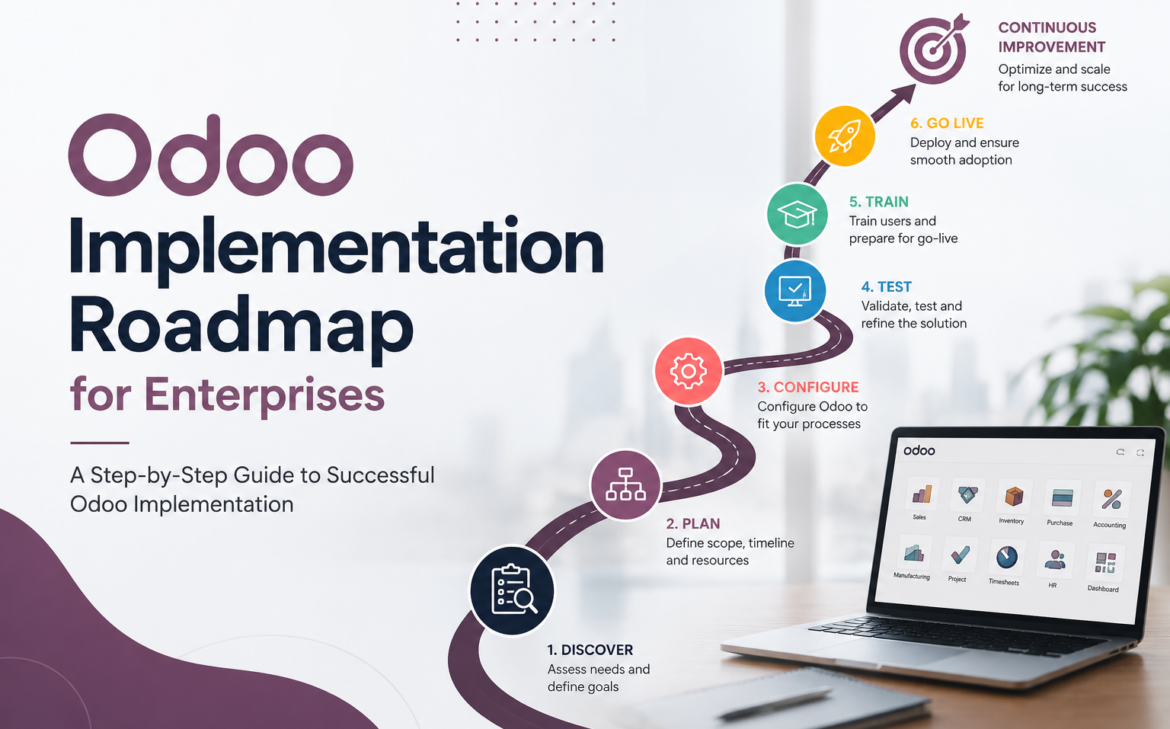
Enterprise ERP projects rarely fail because of software alone. They fail when scope grows faster than decisions, when teams are not aligned, and when implementation turns into a technical exercise instead of an operational one. That is why an odoo implementation roadmap for enterprises should be treated as a business change plan first and a system deployment plan second.
For enterprise leaders, the value of Odoo is not simply that it can unify finance, sales, inventory, procurement, HR, manufacturing, or service operations in one environment. The value comes from designing the rollout in a way that protects continuity, controls cost, and creates measurable improvement. A roadmap gives that structure.
What an enterprise roadmap needs to solve
An enterprise implementation is different from a small business ERP rollout. There are usually multiple departments, more approval layers, existing integrations, legacy data issues, and stronger reporting requirements. In many Gulf-based organizations, there may also be multi-company structures, bilingual users, local compliance needs, and regional operating variations that affect configuration decisions.
That means the roadmap cannot be a simple checklist. It has to define priorities, governance, dependencies, and change ownership. If those pieces are weak, even a well-configured Odoo environment will struggle to deliver the expected business result.
Phase 1 – Define the business case and scope
The first stage of an odoo implementation roadmap for enterprises is not a product demo or module selection. It starts with a clear business case. Leadership should agree on why Odoo is being introduced now, what problems it is expected to solve, and how success will be measured over the first 6 to 12 months after go-live.
That often includes goals such as reducing manual approvals, improving inventory accuracy, shortening month-end closing, increasing order visibility, or replacing disconnected tools that create reporting delays. The more specific the outcome, the easier it is to make the right design decisions later.
Scope also needs discipline at this stage. Enterprises often want to address every process gap at once. That usually creates delays, excessive customization, and a more difficult go-live. A better approach is to separate must-have capabilities from phase-two improvements. This does not mean thinking small. It means sequencing change in a way the business can absorb.
Phase 2 – Run discovery with process owners
Once objectives are clear, discovery should involve the people who run the business day to day. Finance, operations, procurement, sales, warehouse, manufacturing, HR, and IT leaders each see different risks. If requirements are gathered only from senior management, gaps appear later when real users begin testing.
Good discovery maps the current process, the pain points, the approvals, the reports, and the exceptions. It also identifies where standard Odoo workflows can replace old habits and where customization may be justified. This is where many enterprises save money in the long run. A process that can be simplified should not be rebuilt exactly as it exists today.
There is an important trade-off here. Too little discovery creates rework. Too much discovery can slow momentum and turn the project into endless workshops. The right balance is enough detail to make confident design decisions without documenting every minor variation that has little business impact.
Phase 3 – Build governance before configuration starts
Many ERP delays come from decision bottlenecks rather than technical issues. Enterprises need a governance structure early, not halfway through the project. That means naming an executive sponsor, a project manager, and department owners who are responsible for approving process decisions and resolving conflicts.
Without this structure, small questions sit unanswered and timelines drift. With it, teams know who can decide on chart of accounts structure, purchasing workflows, warehouse logic, user roles, approval levels, and reporting priorities.
Governance should also define how change requests will be handled. Some changes are essential. Others are simply preferences that increase cost and complexity. A roadmap works when it protects the project from unnecessary redesign while still allowing room for real business needs.
Phase 4 – Design the solution architecture
At this point, the enterprise can translate business requirements into system design. This includes the Odoo modules to be implemented, the process flows to be configured, the user access model, and any required third-party integrations.
For some organizations, standard Odoo capabilities will cover most requirements. For others, integration with e-commerce platforms, payment systems, POS, logistics tools, legacy applications, or industry-specific software may be necessary. Enterprises should evaluate these carefully. Every integration adds value only if it reduces manual work or improves control. If it merely preserves a weak legacy setup, it may not be worth carrying forward.
Customization decisions also belong here. Custom development can be the right move when it supports a true operational requirement or a competitive process. It becomes a problem when it tries to force the ERP to match outdated behavior. The strongest roadmap keeps customization purposeful and tied to measurable business outcomes.
Phase 5 – Prepare data before it becomes a crisis
Data migration is often underestimated. Yet in most enterprise ERP projects, poor data causes more disruption than software defects. Duplicate customers, inconsistent item codes, missing supplier terms, inaccurate stock balances, and broken account mappings can damage trust quickly after go-live.
That is why data work should begin early. The roadmap should identify which master data will be migrated, which historical data is needed, how data will be cleaned, who owns validation, and what cutover approach will be used.
Not every record deserves to move into the new system. Enterprises often benefit from a more selective migration strategy, especially when the legacy environment contains years of inconsistencies. Clean data supports faster adoption, better reporting, and fewer support issues in the first months of operation.
Phase 6 – Configure, test, and validate by business scenario
Configuration should move in parallel with structured testing. Enterprises should avoid testing only module by module. A better method is scenario-based validation. For example, a real business flow might start with a quotation, move to sales order, inventory allocation, delivery, invoicing, and payment reconciliation. Another might start with procurement planning and end with supplier payment and landed cost treatment.
This kind of testing reveals process gaps that isolated screen testing often misses. It also helps business users see how their department connects with others.
User acceptance testing should not be rushed. If key users are not actively involved, go-live risk rises sharply. They need enough time to test exceptions, not just perfect-path transactions. Returns, discounts, approval overrides, credit limits, stock shortages, and partial deliveries are where enterprise systems are truly tested.
Phase 7 – Plan training and adoption like a change program
Training is not the final presentation before launch. It is an adoption strategy. Different user groups need different levels of depth. Executives care about dashboards and approvals. Finance teams need confidence in transactions and controls. Operational users need speed, clarity, and repetition.
Enterprises should identify super users early and involve them throughout the project. They become internal champions, first-line support contacts, and practical translators between departments and implementation teams. This is especially valuable in organizations with multiple branches or large operational teams.
A strong adoption plan also addresses resistance. Some employees worry that the new ERP will expose errors, change authority, or slow them down. Those concerns are normal. The answer is not only training. It is showing how the new process reduces friction and improves accountability.
Phase 8 – Go live with control, not optimism
Go-live should be treated as a controlled transition. That means confirming data readiness, access rights, training completion, open issue status, and support coverage before the switch happens. It also means deciding whether the rollout will be big bang, phased by module, or phased by entity.
There is no single best model. A big bang rollout can shorten the overall transition but raises operational risk. A phased rollout reduces disruption but can create temporary workarounds between old and new systems. The right choice depends on business complexity, internal readiness, and the criticality of each process.
For many enterprises, a staged rollout provides better risk control, especially when multiple companies, warehouses, or departments are involved. The timeline may be longer, but stability often improves.
Phase 9 – Stabilize, optimize, and measure ROI
The roadmap should continue after launch. The first 30 to 90 days are where adoption gaps, reporting requests, and process refinements become visible. Post-go-live support should be planned in advance, with clear issue ownership, response timelines, and prioritization rules.
This is also the right time to measure whether the project is delivering what the business case promised. Are procurement cycles faster? Is inventory visibility stronger? Has reporting improved? Are finance teams closing with fewer manual adjustments? These are the indicators that matter.
For many organizations, the real return from Odoo appears after stabilization, when phase-two automation, advanced reporting, CRM improvements, manufacturing controls, or customer portal capabilities can be added with more confidence. That is where a partner with both implementation and custom development capability can create stronger long-term value. Machinser often sees the best enterprise results when the roadmap is treated as a managed transformation program rather than a one-time software installation.
Common mistakes that weaken enterprise ERP roadmaps
Most enterprise implementation problems can be traced back to a short list of avoidable issues. Unclear scope creates timeline pressure. Weak executive sponsorship slows decisions. Excessive customization drives cost and future maintenance. Poor data quality damages confidence. Limited user involvement leads to adoption problems.
Another common mistake is choosing timelines based on budget pressure rather than business readiness. Speed matters, but forcing go-live before testing, training, and data validation are complete usually creates higher costs later.
The strongest roadmap is realistic, commercially grounded, and tied to business outcomes. It respects the fact that ERP implementation affects process, people, controls, and reporting all at once.
An enterprise Odoo project works best when leadership sees the roadmap as a decision framework, not just a project schedule. Get that part right, and the system becomes easier to deploy, easier to adopt, and far more likely to improve how the business actually runs.