
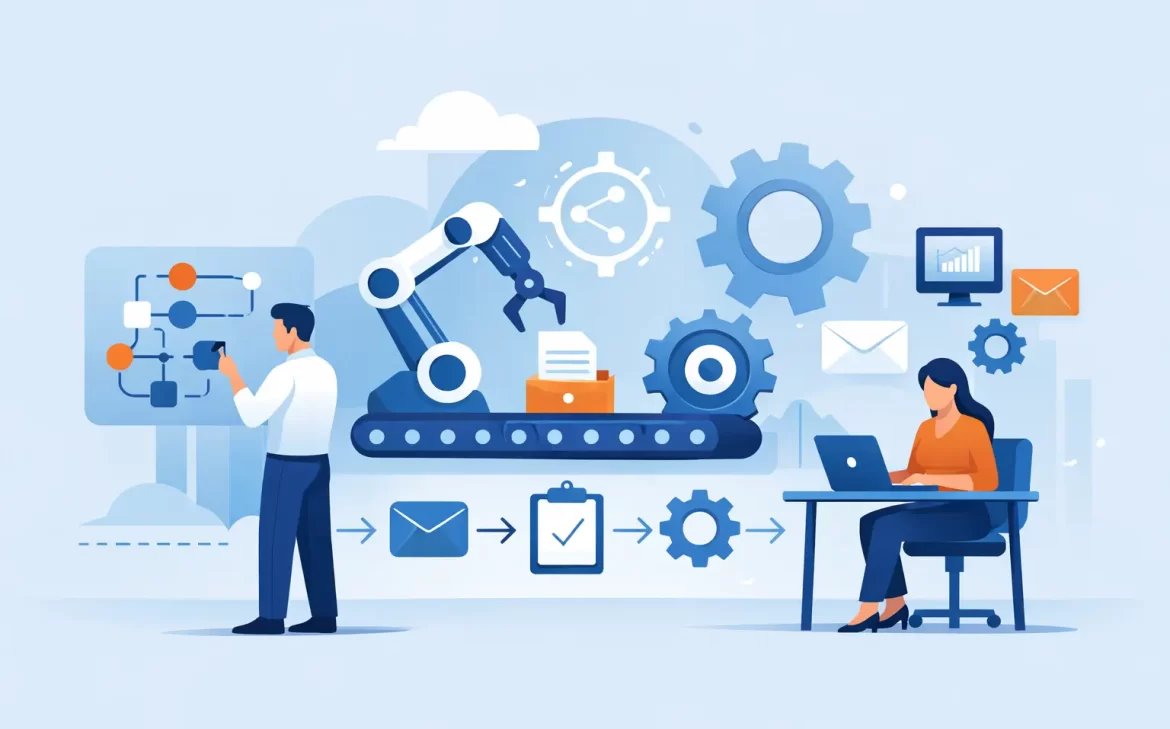
A sales order gets approved in one system, invoiced in another, and fulfilled through a spreadsheet someone updates at the end of the day. That gap is where delays, errors, and missed revenue usually start. If you are asking how to automate business workflows, the real goal is not just speed. It is control, visibility, and a business that can grow without adding friction at every handoff.
For small and mid-sized companies, workflow automation often looks less like a major IT program and more like fixing the daily bottlenecks that slow teams down. The right approach connects departments, standardizes routine tasks, and gives decision-makers a clearer view of what is happening across sales, finance, operations, HR, and service.
What business workflow automation actually means
A business workflow is the path a task follows from start to finish. That might be a lead becoming a customer, a purchase request becoming an approved order, or an employee joining the company and getting system access. Automation means the system handles repeatable actions based on rules, approvals, triggers, and data already available in the business.
That could include sending approval requests automatically, creating invoices when deliveries are confirmed, assigning service tickets by priority, updating inventory after a sale, or notifying managers when payments are overdue. Good automation removes manual chasing and duplicate entry. It also reduces the risk that a process depends too heavily on one person remembering the next step.
This matters because most workflow problems are not caused by a lack of effort. They come from disconnected tools, unclear ownership, and processes that evolved over time without proper structure. Automation works best when it fixes those root issues rather than simply speeding up a broken process.
How to automate business workflows without creating new problems
The fastest way to waste time on automation is to start with software features before defining the process. Many companies automate too early, then discover they have digitized confusion. A better starting point is to identify where work gets delayed, repeated, or lost between teams.
Begin with one high-impact workflow. Choose something frequent, measurable, and closely tied to cost, revenue, or customer experience. Order processing, invoice approvals, procurement, lead follow-up, stock replenishment, and employee onboarding are common starting points because they affect multiple departments and produce visible results.
Map the current process in plain business terms. Who starts it? What information is needed? Where are approvals required? What exceptions happen regularly? Which steps are manual only because systems do not communicate? This step often reveals that the issue is not the number of tasks, but the number of handoffs.
Once the current process is clear, define the future state. Decide what should happen automatically, what still requires human review, and what data must be validated before the workflow moves forward. This is where discipline matters. Not every step should be automated. High-value exceptions, policy decisions, and sensitive financial approvals often still need oversight.
Start with workflows that deliver visible ROI
Companies usually get the best return by automating processes that are both repetitive and cross-functional. Finance and operations are especially strong candidates because delays there create a direct business cost.
For example, purchase approvals can move from email chains to rule-based routing by amount, department, or vendor type. Sales orders can trigger stock checks, delivery creation, and invoice generation automatically. Customer inquiries can be assigned based on territory, service level, or product category. HR onboarding can generate task lists, document requests, and internal notifications without back-and-forth emails.
The common thread is simple. These processes depend on accurate data, timely action, and coordination across teams. When handled manually, they create lag. When automated correctly, they become more predictable.
There is also a practical sequencing advantage here. Once one workflow is working well, the business gains confidence, cleaner data, and a better sense of governance. That makes the next automation easier and less risky.
Why integrated systems matter more than standalone automation
A lot of businesses try to automate workflows using separate tools for forms, approvals, spreadsheets, messaging, accounting, and reporting. That can work for a while, but it often creates another version of fragmentation. You may automate the task but still lose visibility across the process.
Integrated ERP platforms are often a better fit when the workflow touches sales, inventory, purchasing, finance, manufacturing, or HR. Instead of pushing data between disconnected applications, the process runs in a shared environment where each department works from the same record.
That makes automation more reliable. A confirmed quotation can become a sales order. A sales order can reserve stock. A delivery can trigger invoicing. A posted invoice can update financial reporting. Those are not isolated automations. They are connected business events.
For companies in growth mode, this is the difference between patching inefficiency and building operational discipline. It also reduces the reporting gap that many managers face when numbers are updated late or reconciled manually.
Common mistakes when automating business workflows
The biggest mistake is automating an inefficient process without redesigning it. If approvals are unclear, responsibilities overlap, or data entry happens in multiple places, automation may only make the confusion happen faster.
Another common issue is choosing workflows based only on technical ease instead of business value. Automating a minor internal task may be quick, but it will not change much if your order cycle, receivables, or procurement process remains manual.
Poor data quality is another major obstacle. Automation depends on rules, and rules depend on clean data. If customer records are duplicated, item codes are inconsistent, or approval hierarchies are outdated, the workflow will break or create exceptions too often.
There is also a people factor. Teams resist automation when they think it removes control or adds complexity. That is why communication, training, and practical process ownership matter. Staff need to see how automation helps them work more accurately and with less rework, not just how it helps management monitor activity.
What to look for in an automation platform
The platform matters, but fit matters more. A good workflow automation system should support configurable approvals, role-based access, notifications, reporting, and integration with core business functions. It should also be flexible enough to reflect how your business actually operates, not force awkward workarounds.
For many organizations, especially those outgrowing spreadsheets or disconnected software, ERP-led automation makes more commercial sense than buying multiple niche tools. It centralizes data, improves auditability, and gives leadership better reporting across departments.
At the same time, flexibility should not come at the cost of governance. Heavy customization can solve a short-term requirement but create maintenance problems later. The right balance is a system that supports your core workflows well, with customization applied where it creates clear operational value.
This is one reason implementation approach matters as much as software choice. An experienced partner can help define practical workflows, challenge unnecessary complexity, and align automation with business outcomes rather than feature lists. For businesses in the Gulf looking to modernize operations through ERP, Machinser often sees the strongest results when automation is treated as part of process improvement, not just system deployment.
A practical rollout plan that works
If you want to know how to automate business workflows in a way that sticks, think in phases. Start with discovery and process mapping. Then prioritize two or three workflows with clear commercial impact. Build them, test them with real users, and measure results against simple operational metrics such as cycle time, error rate, approval turnaround, or backlog reduction.
After that, expand gradually. Use the first rollout to improve data standards, clarify ownership, and establish internal confidence. This avoids the common problem of trying to automate everything at once, which usually leads to delays and change fatigue.
It also helps to define success beyond efficiency alone. Faster processes matter, but so do stronger controls, cleaner reporting, and better customer response times. In many businesses, the most valuable outcome of automation is not labor reduction. It is the ability to make decisions with timely, trustworthy information.
Automation should support growth, not just reduce admin
The companies that benefit most from workflow automation are not necessarily the largest. They are the ones that have reached the point where manual coordination is limiting growth. Sales slow down because fulfillment is reactive. Finance spends too much time correcting records. Managers rely on follow-up instead of dashboards. Teams work hard, but the operating model does not scale.
That is where automation becomes a strategic move. It helps standardize execution, improve accountability, and create a stronger foundation for expansion. Whether the next step is opening new branches, handling more transaction volume, or improving service quality, automated workflows give the business more consistency under pressure.
A good process should not depend on memory, spreadsheets, or constant intervention. It should move with structure, reflect your policies, and give every team a clearer path from one step to the next. When you approach automation that way, the question stops being whether to automate and becomes which process to fix first.