A growing company rarely decides to buy ERP because everything is going smoothly. The decision usually starts with frustration. Finance is closing the month late. Sales are promising delivery dates without seeing real stock. Warehouse teams are updating spreadsheets after the fact. Management is asking for margin reports that nobody fully trusts. At that point, the Odoo vs SAP Business One discussion becomes practical, not theoretical.
For many SMEs in Saudi Arabia, the UAE, Qatar, Bahrain, Kuwait, Oman, and the wider GCC, ERP is no longer only an accounting system. It is the operating backbone for VAT compliance, invoicing, purchasing, warehouse control, project delivery, ecommerce, approvals, HR, and management reporting. Choosing the wrong system does not just waste software budget. It creates process debt that follows the company for years.
This article compares Odoo and SAP Business One from the point of view of implementation consultants who work with real business teams, not from a brochure checklist. Both platforms are serious ERP options. The question is which one fits your operating model, budget, compliance needs, and growth plan.
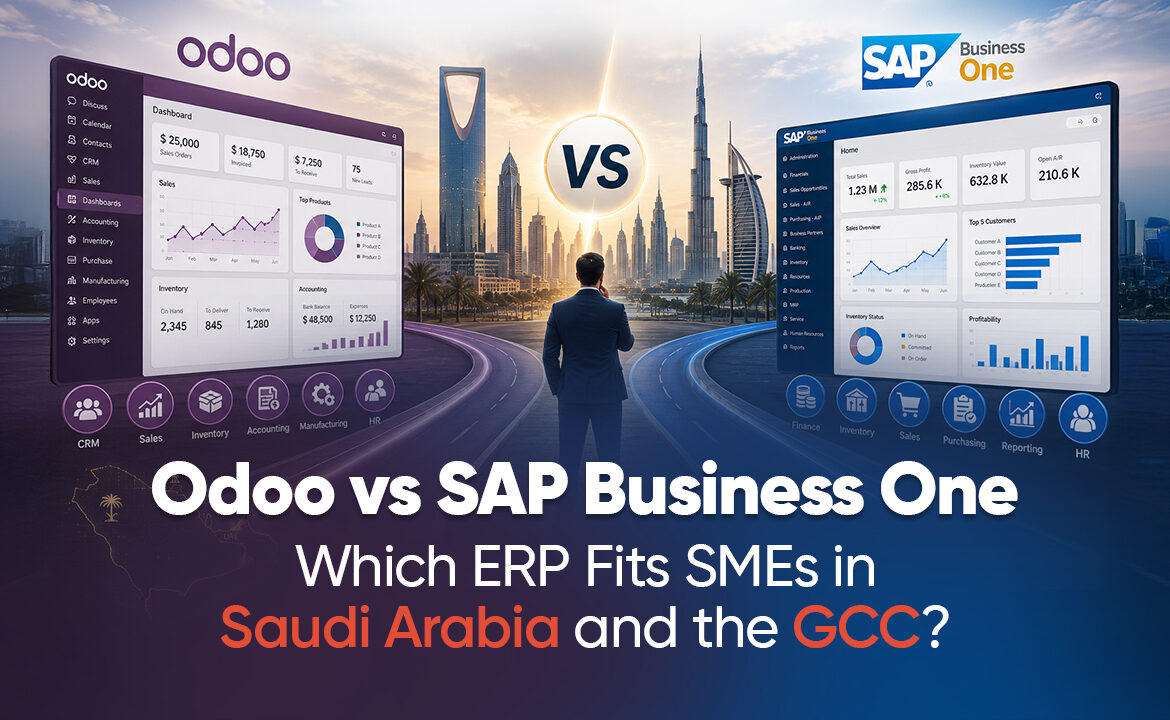
Odoo vs SAP Business One
Odoo is usually the better ERP fit for SMEs in Saudi Arabia and the GCC when the business needs flexibility, phased implementation, local workflow adaptation, ecommerce, manufacturing, or custom automation. SAP Business One can be a good fit when the company wants a more standardized, finance-led ERP structure from a long-established enterprise software vendor. The best choice depends on process complexity, budget, compliance needs, and partner implementation quality.
What is Odoo?
Odoo is a modular ERP platform that brings business applications such as CRM, sales, accounting, inventory, purchasing, manufacturing, POS, ecommerce, HR, projects, field service, and marketing into one connected system. Its biggest strength is adaptability. A company can start with a smaller scope, prove the process, train users, and then expand into more departments.
In practice, that matters in the GCC because many businesses do not operate exactly like textbook ERP processes. A Saudi trading company may combine wholesale, showroom sales, ecommerce, consignment stock, Arabic invoice formats, multiple warehouses, and owner-level approval rules. A manufacturing business may need custom costing logic, quality checks, subcontracting, maintenance, and batch traceability. Odoo gives more room to design ERP around how the business really works, provided the implementation partner applies discipline.
What is SAP Business One?
SAP Business One is an ERP solution designed for small and midsize businesses. It covers core areas such as accounting and financials, purchasing, inventory, sales, customer relationship management, and reporting. It is often selected by companies that want a structured ERP from a globally recognized enterprise software brand.
SAP Business One can be a strong option when the business has stable processes, finance-led control requirements, and a preference for standardized ERP practices. Many companies like the maturity of the ecosystem and the comfort of working with an established vendor. The limitation appears when the business expects the ERP to bend heavily around unusual workflows or frequent process changes.
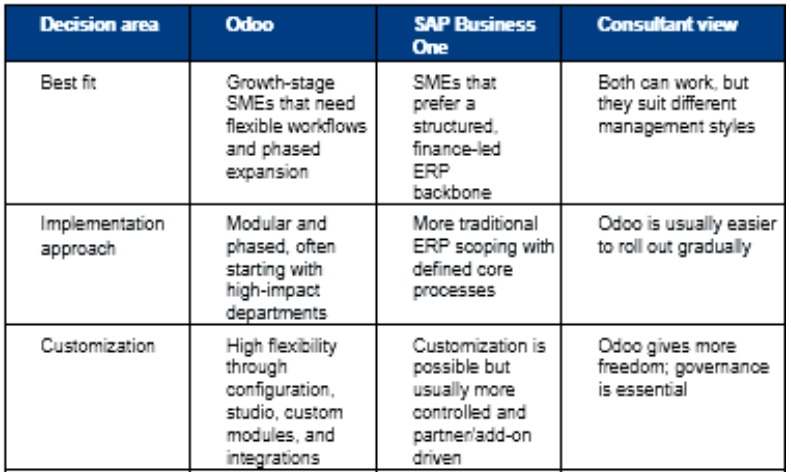
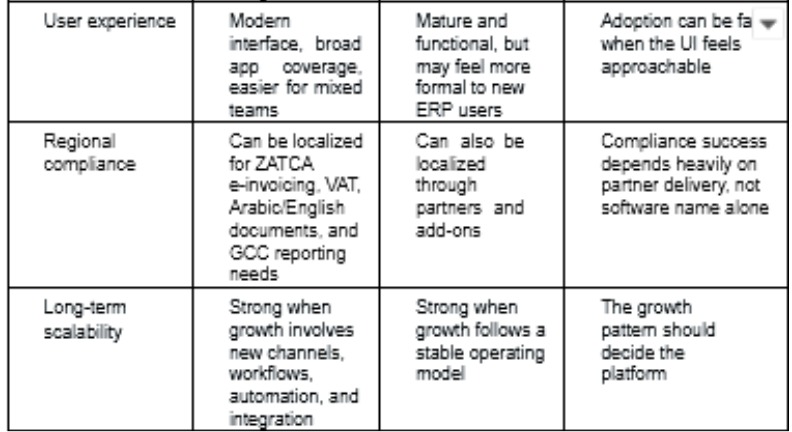
Odoo vs SAP Business One at a glance
What should Saudi and GCC businesses know about ERP cost?
The biggest mistake in ERP buying is comparing subscription prices while ignoring total ownership cost. A realistic budget includes licenses, implementation consulting, localization, data migration, customization, integrations, testing, training, support, and future improvements.
SAP Business One often involves a more traditional ERP investment model. That can include licensing, implementation services, infrastructure or hosting decisions, add-ons, partner support, and future development. For some companies, the structure and maturity justify the cost. For others, especially SMEs still refining their processes, the upfront commitment can feel heavy.
Odoo usually gives more commercial flexibility. Because it is modular, a company can start with finance, sales, inventory, and purchasing, then add manufacturing, HR, CRM, ecommerce, fleet, service, or analytics later. Official Odoo pricing also positions its Standard and Custom plans around all apps under a single fee structure, which makes budgeting easier for companies that want to expand across departments without buying separate software for every function.
The honest consultant’s answer is this: Odoo is not automatically cheap. Poorly controlled customization can make any ERP expensive. But Odoo often lets you spend more of the budget on business-specific outcomes such as automation, reporting, and workflow improvement, instead of locking a large part of the budget into rigid platform overhead.
What about ZATCA, VAT, and GCC compliance?
For Saudi businesses, ERP selection must include ZATCA readiness from day one. Saudi VAT is applied at a standard rate of 15%, and ZATCA e-invoicing has moved beyond simple invoice generation. Phase 2, known as the Integration Phase, began from 1 January 2023 and is rolled out in waves. It requires integration with ZATCA systems through the Fatoora platform, invoice generation in the required format, and additional invoice fields.
This changes how ERP should be implemented. A business cannot treat e-invoicing as a final-stage technical plugin. Master data, customer VAT numbers, product taxes, invoice sequencing, credit notes, debit notes, simplified tax invoices, B2B tax invoices, QR code requirements, user permissions, and audit trails must be planned properly before go-live.
Across the GCC, VAT and tax rules differ by country. UAE businesses, for example, must register for VAT once taxable supplies and imports exceed the mandatory threshold of AED 375,000. A company operating across Saudi Arabia, UAE, Bahrain, Oman, Qatar, or Kuwait should treat localization as a project stream, not an afterthought.
Both Odoo and SAP Business One can support regional compliance when implemented by competent partners. The real question is whether your partner understands local business practice: Arabic and English documents, branch-level reporting, multi-company structures, WHT or zakat-related reporting needs where applicable, approval hierarchies, bank payment formats, audit requirements, and country-specific tax workflows. For Saudi Arabia especially, ask your implementation partner to demonstrate the ZATCA e-invoicing flow before signing the ERP contract.
Which platform is more flexible for customization?
Odoo is usually stronger when the business needs process flexibility. Its modular architecture makes it easier to adjust screens, forms, approval flows, reports, automations, integrations, and role-based workflows. That is why Odoo is often attractive for companies that have mixed operations: trading plus ecommerce, manufacturing plus field service, retail plus wholesale, or logistics plus customer portals.
SAP Business One supports customization too, but the approach is generally more controlled. Businesses often depend on partner add-ons, configuration, or external development to achieve the required fit. This can work very well when requirements are close to standard ERP patterns. It can become slower or costlier when the company wants frequent changes or very specific workflows.
However, flexibility must be managed. One of the worst Odoo implementation mistakes is customizing every department’s old habit into the new ERP. A good Odoo partner will challenge unnecessary customization. The right question is not ‘Can Odoo do this?’ The better question is ‘Should the ERP do this, or should the process be simplified?’
How do Odoo and SAP Business One compare for user adoption?
User adoption is where ERP projects either become business systems or expensive databases. If sales, finance, warehouse, and operations teams do not use the system consistently, reporting will fail no matter how powerful the software is.
Odoo generally feels more approachable for teams moving from spreadsheets, WhatsApp approvals, POS systems, ecommerce dashboards, and standalone accounting tools. The interface is modern, modules are connected, and day-to-day tasks are usually easier to explain in training. This improves data discipline because users are less tempted to create parallel Excel files.
SAP Business One is mature and capable, but some teams may need more structured training, especially if they are new to ERP. That is not a weakness by itself. Many finance teams appreciate structure. But for mixed operational teams, usability should be tested through real scenarios: creating a quotation, checking stock, receiving goods, approving a purchase order, issuing a tax invoice, processing a return, and reading a profitability report.
Which industries fit Odoo better?
Odoo is usually a strong fit for SMEs with changing operations or multiple business models. In Saudi Arabia and the GCC, we often see this in trading companies with multiple warehouses, manufacturers with custom workflows, retail chains with POS, ecommerce businesses, service companies with projects and timesheets, logistics businesses with fleet or delivery workflows, and companies that want customer portals or mobile-friendly operations.
Consider a Riyadh-based building materials trader. The company sells to contractors, runs a showroom, manages bulk stock, offers customer-specific pricing, handles delivery scheduling, and wants Arabic and English invoices. Odoo can connect CRM, sales, inventory, accounting, purchases, approval rules, delivery operations, and customer follow-up in one flow. SAP Business One can support the core back-office requirements, but Odoo may be easier if the company wants to add ecommerce, automated WhatsApp-style notifications through integration, custom sales approvals, or a customer portal.
Now consider a finance-led distribution business with stable processes, limited customization needs, and a management team that wants a traditional ERP structure. SAP Business One may fit well. If the main objective is strong financial control, inventory visibility, purchasing discipline, and standard reporting, the structured approach can be an advantage.
Which industries fit SAP Business One better?
SAP Business One is often attractive for companies that want a conventional ERP backbone and are comfortable adapting to standard processes. It can work well for wholesale distribution, trading, light manufacturing, and businesses where finance, inventory, purchasing, and reporting are the dominant requirements.
The best SAP Business One projects usually have clear scope, committed finance leadership, well-defined master data, and a company culture that accepts process standardization. If your business wants to minimize custom workflows and follow established ERP structures, SAP Business One deserves serious consideration.
Implementation challenges and how to avoid them
ERP failure rarely happens because one feature is missing. It usually happens because the project starts without process ownership. The most common problems are unclear scope, messy master data, weak user training, over-customization, poor testing, and lack of post-go-live support.
For Odoo, the main risk is uncontrolled flexibility. The solution is a proper business analysis phase, a signed process blueprint, clear customization rules, phased delivery, user acceptance testing, and structured Odoo Training before go-live. For SAP Business One, the main risk is forcing the business into a process model that users resist. The solution is early process workshops, realistic change management, and honest gap analysis before contract finalization.
In our implementation experience, the best ERP projects have one thing in common: management treats ERP as a business transformation project, not an IT purchase. The project sponsor attends workshops.
Department heads take ownership of data. Users test real transactions before go-live. Support is planned from day one. That is where Odoo Implementation Services, Odoo Customization, Odoo Integration Services, Odoo Support, Odoo Training, and Digital Transformation Consulting become practical business services rather than marketing terms.
Should you choose Odoo or SAP Business One?
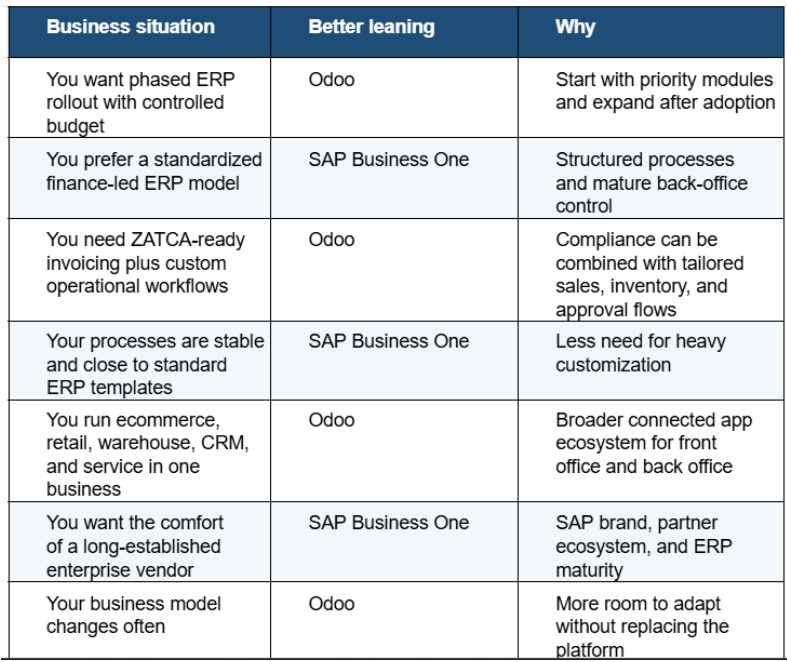
Final verdict: Odoo vs SAP Business One
Odoo is usually the better fit for growing SMEs in Saudi Arabia and the GCC that need flexibility, phased implementation, multi-department expansion, ecommerce, manufacturing adaptation, custom reports, and automation. It is especially useful when the company wants one platform that can evolve with the business rather than forcing every department into a fixed structure.
SAP Business One remains a credible ERP choice for SMEs that prefer standardized processes, strong back-office discipline, and a traditional ERP model from an established global vendor. It can be the right answer when the business has stable requirements and does not expect heavy workflow customization.
The safest decision is not to choose based on brand familiarity alone. Ask for a process demo using your own business scenarios. Test ZATCA e-invoicing or VAT flows. Review migration complexity. Compare the cost of year-one implementation and year-three expansion. Most importantly, evaluate the partner. A good implementation partner can make a flexible ERP disciplined. A weak partner can make even the strongest ERP painful.
If your business needs a system that can centralize operations, support regional compliance, improve reporting, and grow with changing business models, Odoo often offers the stronger long-term fit. The best ERP is the one your teams will actually use, your management can trust, and your business can build on with confidence.
FAQ
Is Odoo better than SAP Business One?
Odoo is better when a business needs flexibility, phased rollout, customization, ecommerce, workflow automation, and easier user adoption. SAP Business One can be better when a business wants a more standardized, finance-led ERP structure with less process variation.
Is SAP Business One suitable for SMEs in Saudi Arabia?
Yes. SAP Business One is designed for small and midsize businesses and can support finance, sales, purchasing, inventory, CRM, and reporting. Its suitability depends on localization, partner capability, cost, and how closely your processes match standard ERP workflows.
Can Odoo support ZATCA e-invoicing?
Odoo can support ZATCA e-invoicing when properly localized and integrated. Saudi businesses should verify Phase 2 readiness, Fatoora integration, invoice formats, required fields, QR codes, credit notes, debit notes, and audit trail requirements during implementation.
Which ERP is more affordable, Odoo or SAP Business One?
Odoo is often more budget-flexible because companies can implement modules in phases and expand later. SAP Business One may involve a more traditional ERP cost structure. The real comparison should include licenses, implementation, customization, integrations, training, support, and future changes.
Which ERP is better for manufacturing companies in the GCC?
Odoo is often better for manufacturers with custom workflows, variable production processes, maintenance, quality checks, subcontracting, or ecommerce connections. SAP Business One can work well for manufacturers with stable and standard production processes.
Which ERP is better for trading and distribution businesses?
Both can work. SAP Business One is strong for structured finance, inventory, purchasing, and sales control. Odoo is often stronger when the trading business also needs CRM, ecommerce, warehouse customization, customer portals, or flexible approval workflows.
How long does an Odoo implementation take?
A focused Odoo implementation for core finance, sales, inventory, and purchasing can often be delivered in phases. Exact timelines depend on data quality, integrations, customization, approval cycles, user availability, and testing discipline.
What should we ask an ERP partner before choosing Odoo or SAP Business One?
Ask for industry references, a live process demo, ZATCA or VAT compliance proof, migration approach, customization governance, training plan, support model, integration experience, and a phased roadmap for future modules.
Can we migrate from SAP Business One to Odoo later?
Yes, migration is possible, but it must be planned carefully. Master data, opening balances, historical transactions, inventory valuation, customer/vendor ledgers, tax records, and reporting continuity should be reviewed before migration.
Do we need Odoo customization?
Most companies need some configuration, but not every company needs heavy customization. Good Odoo consultants first simplify the process, then customize only what creates measurable business value or compliance necessity.
Planning to replace spreadsheets, disconnected software, or an ERP that no longer fits your operations? Speak with our Odoo consultants for a practical ERP readiness assessment. We can review your current processes, map ZATCA and VAT requirements, estimate implementation scope, and recommend whether Odoo, SAP Business One, or another ERP direction fits your business best.
Explore our تنفيذ اودو Services, Odoo Customization, Odoo Integration Services, Odoo Support, Odoo Training, and Digital Transformation Consulting to build an ERP roadmap that works for your Saudi or GCC business.