
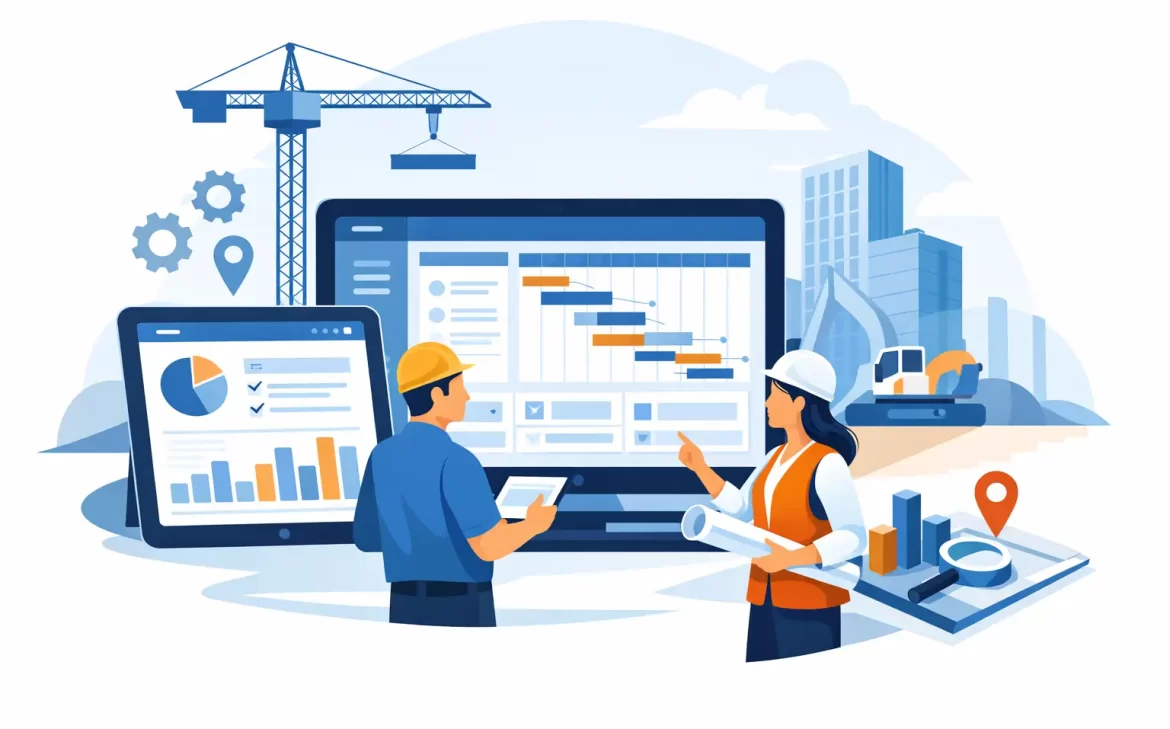
A project looks profitable on paper until the site team, procurement team, and finance team are all working from different numbers. One spreadsheet says materials are delayed, another shows the vendor is cleared, and the project manager is chasing updates in calls and messages. That is exactly where construction ERP for project tracking starts to matter – not as another software purchase, but as a way to bring cost, schedule, resources, and reporting into one operational view.
For construction businesses, tracking a project is never just about task status. It is about knowing whether labor is being used efficiently, whether procurement is aligned with site execution, whether subcontractor bills match actual progress, and whether the margin is still intact after every change order. If those answers take days to assemble, leadership is already reacting too late.
Why construction project tracking breaks down
Most growing contractors do not struggle because they lack effort. They struggle because information is scattered across accounting systems, Excel files, WhatsApp updates, standalone project tools, and manual approvals. Each department sees part of the picture, but nobody sees the full picture in real time.
This creates familiar problems. Budget overruns show up after invoices are posted. Material shortages are discovered when crews are already on site. Equipment allocation gets handled informally, so one project has idle machines while another is waiting. Progress billing becomes slower because project data and finance data do not match. None of this is unusual. It is what happens when project tracking is disconnected from core business operations.
That is the practical advantage of a construction ERP for project tracking. It connects planning, procurement, accounting, inventory, contracts, timesheets, and reporting so project performance is measured from actual business activity, not separate updates entered after the fact.
What construction ERP for project tracking should actually cover
A useful ERP setup does more than show a task list. For construction companies, project tracking must reflect how work is delivered and how money moves.
Cost tracking by project and activity
The first requirement is clear cost visibility. Management should be able to see committed costs, actual costs, budget consumed, and expected variance by project, phase, or work package. This matters because total project cost is rarely the issue. The real issue is where the overrun begins and how early the business can catch it.
If steel pricing changes, subcontractor scope expands, or site productivity drops, the system should make that visible quickly. A generic tool may show that a project is active. An ERP should show whether that activity is still commercially healthy.
Timeline and milestone control
Construction schedules shift. That is normal. What matters is whether schedule changes are isolated or whether they start affecting procurement, labor planning, billing, and client commitments. A proper ERP-based tracking environment links milestones to operational triggers. If a milestone slips, decision-makers should see what else moves with it.
This does not mean every contractor needs a complex scheduling engine inside ERP. In some cases, ERP should integrate with the scheduling process rather than replace it. The key point is that project tracking should not end with dates on a plan. It should translate delays into business impact.
Resource and site coordination
Labor, machinery, subcontractors, and materials need to be aligned at the project level. When resource planning is handled separately, waste increases fast. One crew waits for materials. Another project over-orders stock. Equipment utilization drops because assignments are not centrally visible.
Construction ERP improves this by giving teams a shared operational record. Resource decisions become easier because project managers and back-office teams are not working from separate assumptions.
Progress billing and financial reporting
Many contractors feel project pressure first in cash flow, not just in delivery. If work is completed but billing is delayed, the project may look busy while liquidity tightens. ERP helps connect progress updates, contract terms, variations, invoices, receivables, and financial reporting.
This is one of the most important differences between simple project software and ERP. Project tracking becomes financially meaningful. Leaders can see not only what is happening on site, but how it affects revenue recognition, collections, and profitability.
The business case for ERP in construction tracking
For owners and operations leaders, the decision is rarely about software features alone. It is about control. When projects scale, the cost of poor visibility rises with them.
A well-implemented ERP can reduce duplicate data entry, shorten approval cycles, improve procurement timing, and give finance teams cleaner project-level reporting. It can also improve accountability. When purchase requests, stock movements, timesheets, subcontractor bills, and client invoices are tied to the project record, it becomes easier to identify delays, bottlenecks, and leakage.
There is also a management benefit that is often overlooked. Better project tracking changes the quality of internal conversations. Instead of debating whose spreadsheet is correct, teams can focus on action. That saves time, but more importantly, it improves decision speed.
Where companies get it wrong
Not every ERP project delivers this value. In construction, implementation quality matters as much as product selection.
One common mistake is choosing software that works well for accounting but poorly for operational project control. Another is trying to force construction processes into generic workflows that ignore variation orders, subcontractor management, site approvals, retention, or staged billing.
There is also the opposite problem – overengineering. Some businesses ask for every possible customization before the core process is stabilized. That usually slows adoption and increases cost without solving the main visibility problem. The better approach is to start with the high-impact workflows: budgeting, procurement, job costing, billing, and project reporting. Once those are working well, more advanced controls can be layered in.
Data discipline matters too. ERP will not fix weak process ownership by itself. If project codes are inconsistent, approvals are bypassed, or teams still rely on side channels for critical updates, reporting will remain unreliable. The system needs to be matched with practical governance.
How to evaluate the right setup
The best choice depends on business size, project complexity, and internal maturity. A smaller contractor may need straightforward project-cost control and mobile-friendly site updates. A larger business may need multi-company reporting, subcontract management, equipment tracking, and deeper financial controls.
That is why buyers should evaluate ERP in terms of real workflows, not broad marketing claims. Ask how the system handles project budgets, BOQs, material requests, purchase approvals, site consumption, variation orders, subcontractor valuation, and customer invoicing. Ask what reports can be generated without manual consolidation. Ask how field teams will actually use it.
Implementation support should be part of that evaluation. Construction businesses do not just need software access. They need process mapping, configuration, migration planning, training, and post-go-live support. For many organizations, that is the difference between an ERP that becomes central to operations and one that turns into an expensive reporting layer.
For companies in construction and contracting, this is where an experienced Odoo and ERP implementation partner like Machinser can add value – not by pushing a standard package, but by aligning the system with how projects, finance, procurement, and field operations really work.
What successful adoption looks like
When construction ERP for project tracking is implemented well, the results are visible quickly. Project managers spend less time chasing updates. Procurement teams can plan with more confidence. Finance gets cleaner job-cost data. Leadership sees budget exposure and billing status earlier.
Just as important, teams start trusting the numbers. That trust is what allows a business to scale. If every new project increases administrative friction, growth becomes harder to manage. If every project feeds one reliable system, growth becomes more controlled and more profitable.
There are trade-offs, of course. ERP requires investment, process discipline, and change management. Some workflows will need to be standardized. Some legacy habits will need to stop. But for construction businesses that are tired of managing projects through disconnected tools, the trade-off is usually worth it.
The real goal is not simply to track more data. It is to run projects with clearer visibility, faster decisions, and stronger financial control. When that happens, project tracking stops being a reporting exercise and becomes a real management advantage.