

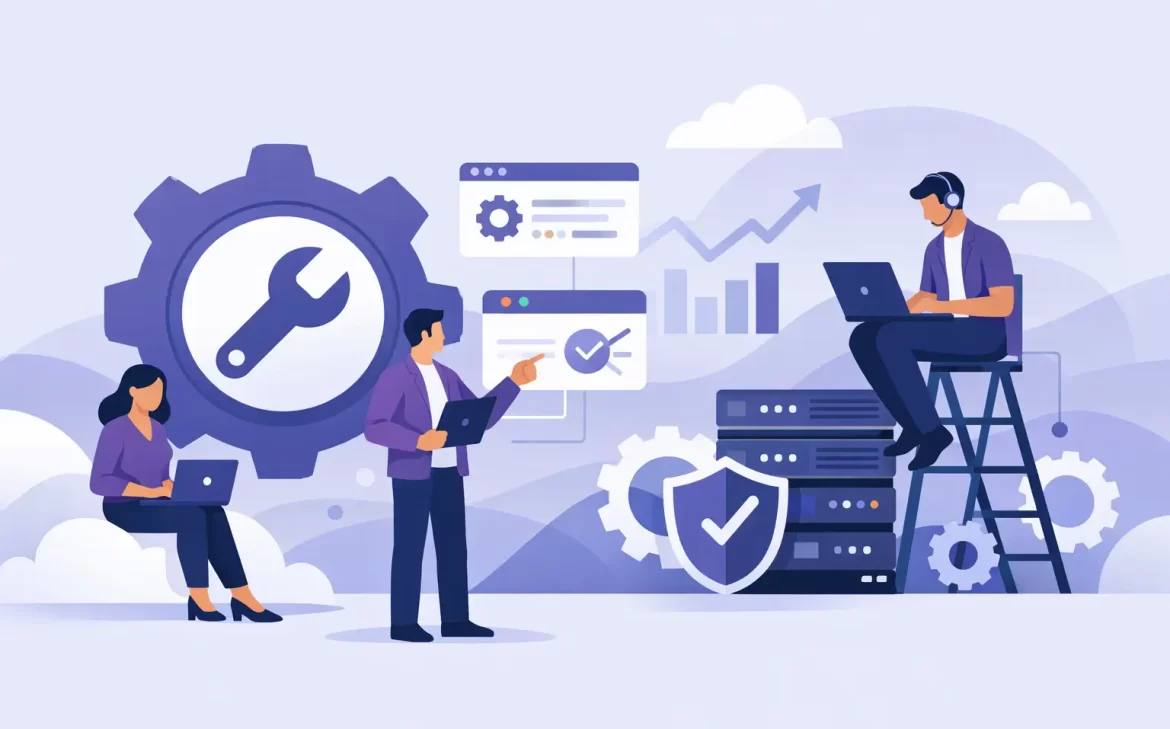
An Odoo rollout does not fail because the software is weak. It usually struggles when the business assumes go-live is the finish line. In reality, odoo support and maintenance is what keeps your ERP usable under pressure – when users grow, processes change, customizations expand, and reporting becomes more critical.
For companies running finance, sales, inventory, HR, manufacturing, or service operations through Odoo, the real question is not whether support is needed. It is how structured that support should be, who should own it, and how quickly issues can be resolved before they affect customers, cash flow, or internal productivity.
Why odoo support and maintenance matters after go-live
The first few months after implementation often reveal what testing could not fully simulate. Users adopt the system in different ways. Departments ask for small process changes. Data quality issues appear. A workflow that looked fine in a workshop may slow down actual operations.
This is where ongoing support becomes commercially important, not just technically useful. If a purchase approval stalls, inventory numbers are wrong, invoices do not post correctly, or a custom field disrupts reporting, the impact reaches beyond the IT team. It affects margins, decision-making, and service quality.
Maintenance plays a different but equally important role. Support handles incidents, questions, and fixes. Maintenance keeps the system healthy over time through version updates, performance review, security checks, bug resolution, and controlled optimization. One is reactive by nature. The other is preventive. Businesses need both.
What good Odoo support actually includes
Not every support arrangement delivers the same value. Some providers only respond when something breaks. That may work for a very small operation with limited system usage, but it becomes risky once Odoo is tied to daily transactions and multi-team workflows.
Effective support usually includes user assistance, issue diagnosis, bug fixing, role and access adjustments, minor workflow corrections, and guidance on how to use existing features better. In a more mature setup, it should also cover change requests, custom module monitoring, integration troubleshooting, and reporting adjustments.
For management teams, responsiveness matters, but so does context. A support partner should understand how your business operates, which modules are business-critical, and what a delay actually costs. A payroll issue, warehouse sync error, or failed approval chain cannot be treated like a generic help desk ticket.
The maintenance side is where long-term value is protected
Odoo systems evolve. New apps are introduced, customizations increase, and business rules become more complex. Without regular maintenance, even a successful implementation can become slower, less stable, and harder to change.
Maintenance often includes monitoring server health, reviewing logs, checking backups, validating integrations, improving load speed, testing updates, and verifying that custom developments still behave as expected. Security also belongs here. User roles, permissions, patching, and environment management should be reviewed on a schedule, not only after an issue appears.
There is also a cost angle many businesses miss. Neglecting maintenance usually creates more expensive work later. A small unresolved issue can turn into data inconsistency, duplicate manual effort, or a larger rework project. Planned maintenance is usually cheaper than corrective firefighting.
When businesses usually realize they need stronger support
The signs are not always dramatic. Often, they show up as friction. Teams start keeping backup spreadsheets because they do not fully trust system output. Managers wait too long for reports. Users repeat the same mistakes because nobody closes the training gap. Custom features exist, but no one is sure who owns them.
In regional businesses across Saudi Arabia and the Gulf, another common trigger is growth. A company expands locations, adds legal entities, launches new product lines, or introduces field teams. Odoo can support that growth well, but only if the support model keeps pace. What worked for a single-office setup may not work for a multi-branch operation with more approvals, more users, and tighter reporting expectations.
If every issue depends on one internal power user, the setup is already fragile. If upgrades keep getting delayed because the business fears disruption, maintenance is not under control. If customizations were built without documentation, support costs will rise over time.
Choosing between ad hoc help and a support plan
Some companies prefer ad hoc support because it looks flexible and inexpensive. For occasional minor questions, that can be reasonable. But it becomes inefficient when the ERP is central to daily operations.
A structured support plan gives the business clearer response times, better issue tracking, and continuity of knowledge. It also helps prioritize work. Not every request should be handled the same way. A login issue, a tax configuration problem, and a custom manufacturing workflow bug do not carry equal urgency.
The right model depends on system complexity, number of users, amount of customization, and operational dependency. A simple Odoo setup may only need periodic maintenance and limited support hours. A distribution, manufacturing, healthcare, retail, or service organization with integrated workflows will usually benefit from ongoing coverage.
The key is to avoid paying either too little or too much. Under-support creates business risk. Over-engineered support adds cost without practical value. A good partner helps define the right support scope based on actual usage, not a standard package alone.
What to look for in an Odoo support partner
Technical skill is expected. The better differentiator is whether the partner can connect system behavior to business outcomes. That matters when decisions involve customizations, process changes, integrations, or version planning.
A reliable support partner should be able to separate quick fixes from root-cause issues. If the same problem keeps returning, the answer is not more ticket closure. It is process review, configuration correction, user retraining, or development cleanup.
Communication also matters more than many buyers expect. Business leaders do not want vague technical language when operations are affected. They want clarity on the issue, the impact, the fix, the timeline, and whether it is likely to happen again. Strong support teams communicate in business terms, not only developer terms.
Regional fit can also make a difference. For companies operating in Saudi Arabia, Bahrain, or the UAE, support often needs awareness of local business practices, operating models, and growth patterns. This is one reason organizations work with firms like Machinser that combine Odoo expertise with practical consulting, customization, and long-term operational support.
Common trade-offs in Odoo support and maintenance
There is no single perfect model. Faster response times usually cost more. Heavy customization can improve fit, but it can also increase maintenance effort. Frequent updates can improve security and features, but they require careful testing to avoid disruption.
This is why support decisions should be tied to business priorities. If uptime and transaction speed are critical, performance monitoring deserves more attention. If your operation changes often, flexible support for process adjustments may matter more than a basic break-fix model. If reporting drives executive decisions, data integrity checks and validation should be part of maintenance.
Another trade-off is internal ownership versus external reliance. Internal teams know the business well, but they may not have deep Odoo troubleshooting or upgrade experience. External specialists bring platform expertise, but they need proper documentation and access to work efficiently. In many cases, the best approach is shared ownership.
How to make support more effective from the start
Businesses get better outcomes when support is treated as an operating function, not an emergency response. That starts with basic discipline: document customizations, assign system owners, define escalation paths, track recurring issues, and review support trends regularly.
It also helps to classify requests properly. User questions, defects, enhancement requests, and strategic improvements should not all sit in the same queue. When they do, urgent issues get mixed with low-priority changes, and everyone feels the service is slow.
Regular review meetings can create outsized value. They show which departments need retraining, which processes need adjustment, and which recurring tickets point to a deeper system design issue. Support should not only fix problems. It should generate insight that improves the ERP over time.
The companies that get the most from Odoo are rarely the ones that spend the least after implementation. They are the ones that stay proactive, keep the system aligned with operations, and treat maintenance as part of business continuity. If your ERP runs core processes, support is not overhead. It is part of keeping the business controlled, scalable, and ready for what comes next.
1 Comment