Inventory costing is more than assigning a price to a product. It affects the value of your stock, the cost of goods sold, and the profit shown in your financial reports.
Imagine a business that purchases the same product several times at different prices. The first batch costs ₹100 per unit, the next costs ₹120, and a later batch costs ₹130. When the business sells one unit, which purchase cost should Odoo use?
The answer depends on the costing method configured for the product category.
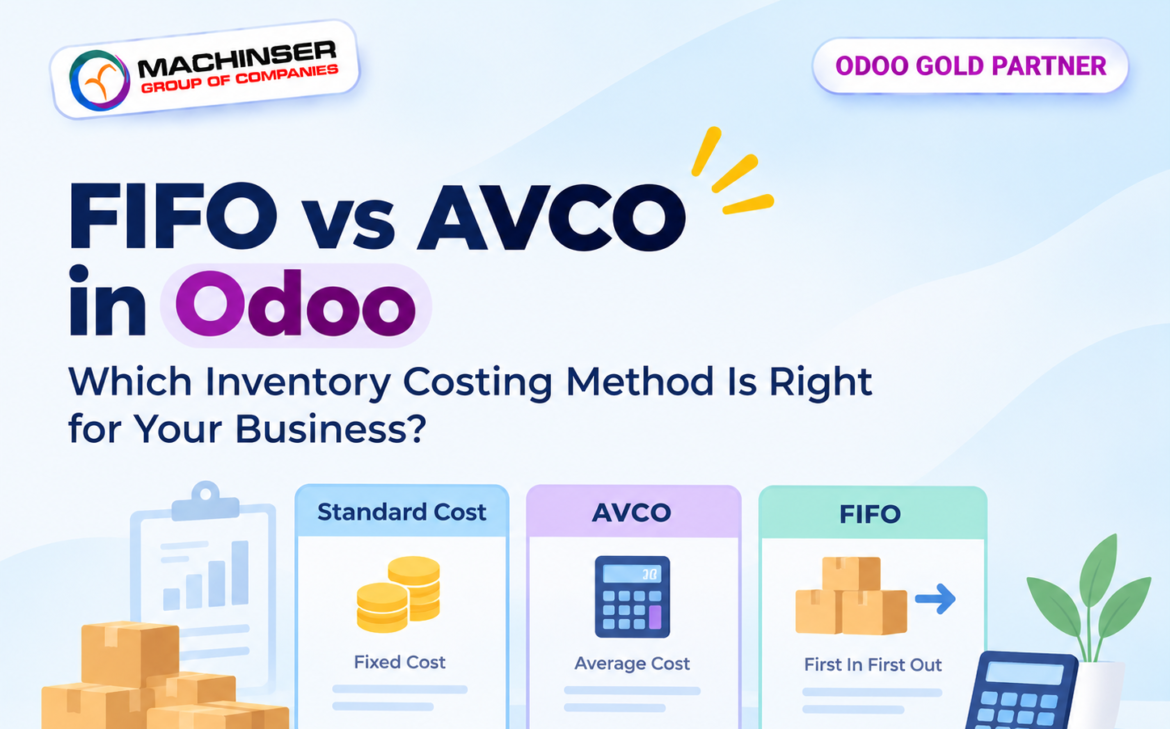
The Three Main Costing Methods
- Standard Price: Uses a manually maintained cost.
- Average Cost (AVCO): Calculates the average cost of available inventory.
- First In First Out (FIFO): Uses the cost of the earliest inventory layer first.
In this guide, we explore how these methods work in Odoo 19, compare them with practical examples, and explain how to choose the right method for your business.
What Is Inventory Costing in Odoo?
Inventory costing is the method used to determine the financial value of products held in stock and the cost assigned to products when they are sold or consumed.
For example, a wholesale business purchases 100 units of a product at ₹100 each. A week later, it purchases another 100 units at ₹120 each. The business now has 200 units, but they were not purchased at the same price.
When some of these units are sold, Odoo needs a method to calculate their cost. This is where Standard Cost, AVCO, and FIFO become important.
The selected costing method can influence:
- Inventory valuation
- Cost of goods sold (COGS)
- Product profitability
- Manufacturing costs
- Financial reporting
Important: In Odoo, the costing method is configured at the product category level. Products assigned to that category follow its costing method.
Understanding the Three Costing Methods
A. Standard Price – A Fixed Cost for the Product
Standard Price uses a predefined cost for a product. The cost does not automatically change every time the business purchases the product at a different price.
Example: A company sets the standard cost of a product at ₹100 per unit.
|
Transaction |
Purchase price |
Standard cost |
|
First purchase |
₹100 |
₹100 |
|
Second purchase |
₹120 |
₹100 |
|
Third purchase |
₹130 |
₹100 |
Even if the supplier increases the purchase price, the product’s standard cost remains ₹100 until someone updates it.
When is Standard Price useful?
- Businesses that work with relatively stable product costs.
- Companies that want a predefined cost for planning.
- Manufacturing businesses that use planned or estimated production costs.
Example: A furniture manufacturer may set a standard cost for a chair based on its expected material and production expenses. The actual cost may vary, but the standard cost provides a consistent reference.
B. Average Cost (AVCO) – Cost Based on Average Inventory Value
Average Cost, commonly called AVCO, calculates the average cost of the inventory currently available. When new stock is received at a different price, Odoo recalculates the average cost based on the existing inventory value and the incoming inventory value.
|
Purchase |
Quantity |
Unit price |
Total value |
|
First |
100 |
₹100 |
₹10,000 |
|
Second |
100 |
₹120 |
₹12,000 |
|
Third |
100 |
₹130 |
₹13,000 |
|
Total |
300 |
₹35,000 |
Average cost = ₹35,000 ÷ 300 = ₹116.67 per unit (approximately).
If the company sells 50 units, the cost assigned to those units is approximately ₹5,833.50.
When is AVCO useful?
- Retail and wholesale businesses.
- Businesses that purchase the same products at changing prices.
- Companies that prefer a blended cost rather than tracking individual purchase layers.
Example: A grocery wholesaler purchases cooking oil from suppliers at different prices throughout the month. AVCO provides an average cost based on the inventory received and still available.
C. FIFO – First In First Out
FIFO stands for First In First Out. Under this method, the cost of the earliest received inventory is used first when calculating the cost of products leaving stock.
|
Purchase batch |
Quantity |
Unit cost |
|
Batch 1 |
100 |
₹100 |
|
Batch 2 |
100 |
₹120 |
|
Batch 3 |
100 |
₹130 |
The company now has 300 units and sells 150 units. Under FIFO, the first 100 units are valued at ₹100 each and the next 50 units are valued at ₹120 each.
Cost of sale = (100 × ₹100) + (50 × ₹120) = ₹16,000.
|
Remaining batch |
Quantity |
Unit cost |
Value |
|
Batch 2 |
50 |
₹120 |
₹6,000 |
|
Batch 3 |
100 |
₹130 |
₹13,000 |
|
Total |
150 |
₹19,000 |
When is FIFO useful?
- Businesses dealing with products purchased at changing prices.
- Companies that want inventory costs to follow receipt order.
- Businesses that manage stock with batches or dated inventory.
Example: An electronics distributor purchases the same accessory at different prices over several months. FIFO helps calculate the cost of outgoing stock using the oldest cost layers first.
How to Configure Costing Methods in Odoo 19
Odoo allows you to configure the costing method from the product category. Follow these steps to set it up.
- Go to Inventory → Configuration → Product Categories.
- Open an existing category or create a new one. Locate the Inventory Valuation section.
- Select Standard Price, Average Cost (AVCO), or First In First Out (FIFO) as the costing method.
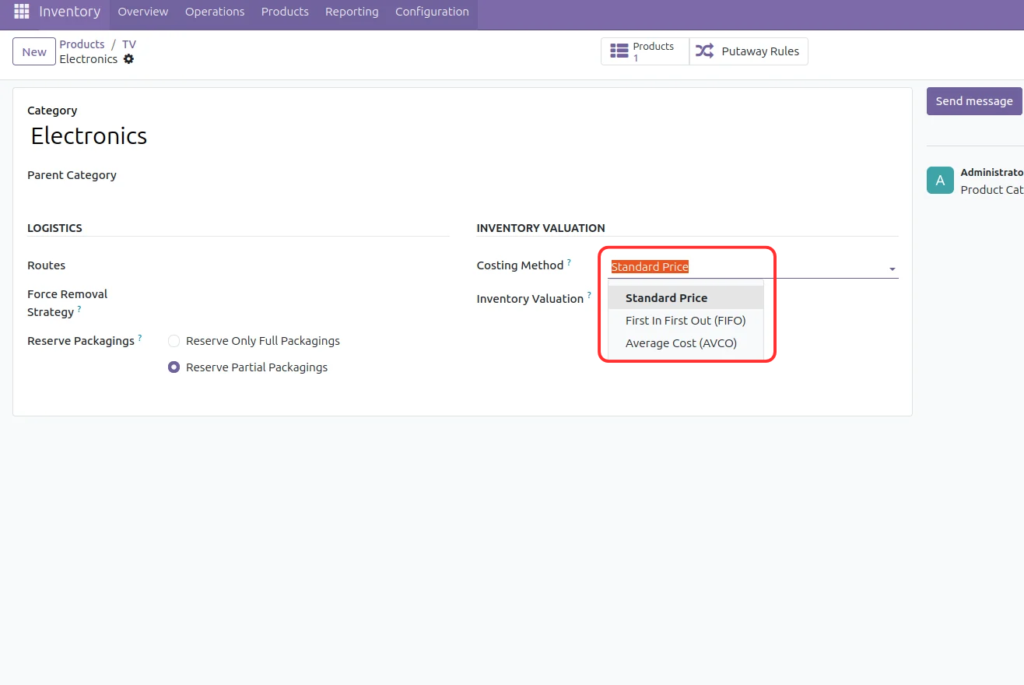
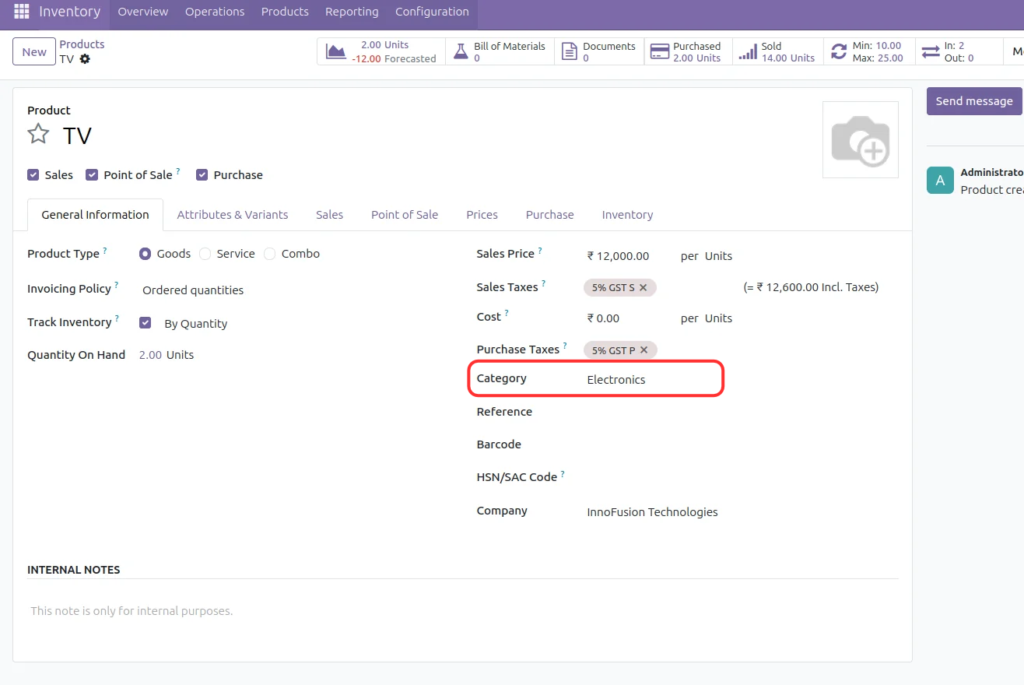
After saving the category, open the relevant product and assign it to that category. The second screenshot shows the TV product assigned to the Electronics category.
Manual valuation updates inventory valuation through periodic accounting entries. Automated valuation creates relevant accounting entries when stock valuation changes. Automated valuation requires the appropriate stock valuation and accounting accounts to be configured.
The exact options visible can depend on installed applications and database configuration. Review the accounting implications before changing settings in a live database.
FIFO vs AVCO: A Practical Comparison
Using the same example, a business purchases 300 units: 100 at ₹100, 100 at ₹120, and 100 at ₹130. It then sells 150 units.
|
Costing method |
Cost assigned to 150 units sold |
Remaining stock value |
|
Standard Price (₹100) |
₹15,000 |
₹15,000 |
|
AVCO (₹116.67) |
₹17,500.50* |
₹17,500.50* |
|
FIFO |
₹16,000 |
₹19,000 |
Calculated using the average cost of ₹116.67 per unit, rounded to two decimal places. Actual Odoo valuation may retain greater precision.
The results differ because each costing method applies a different approach to assigning costs. Standard Price keeps the predefined cost, AVCO uses a blended average cost, and FIFO uses the oldest remaining cost layers first.
There is no single method that always produces the highest profit. The result depends on purchase prices, stock movements, and the method selected.
FIFO and Product Returns in Odoo
Returns are an important part of inventory management. Consider a business that sells a product and later receives some of those units back from the customer.
With FIFO, the cost associated with a return can matter because inventory valuation is based on cost layers. When a return is linked to the original delivery, Odoo can use the original movement’s valuation information when reversing the stock movement.
Practical recommendation: Process customer returns using the original delivery’s return action whenever appropriate. This helps keep the return linked to the original transaction.
Understanding Costing Methods in Manufacturing
Costing methods are also relevant to manufacturing businesses. Imagine a company that manufactures wooden tables using wooden boards, screws, paint, labour, and production operations.
The total manufacturing cost can include the cost of components and other production costs configured in the manufacturing workflow. The costing method determines how the cost of inventory is valued as products enter or leave stock.
This makes costing methods important for understanding the value of raw materials, the cost of finished products, the cost of products sold, and the value of remaining inventory.
The exact manufacturing valuation also depends on the Bill of Materials, component consumption, operations, and the manufacturing and accounting configuration.
FIFO Costing vs FIFO Stock Removal: What Is the Difference?
Both features use the term FIFO, but they serve different purposes.
FIFO Costing Method
FIFO costing determines how Odoo assigns costs to outgoing inventory and values the remaining stock.
FIFO Removal Strategy
The FIFO removal strategy determines which physical stock is selected for an outgoing transfer. It prioritises the stock that entered the location first.
For example, if Batch A was received on 1 November and Batch B on 10 November, FIFO removal prioritises Batch A when preparing an outgoing transfer.
Selecting FIFO as the costing method does not automatically mean that the FIFO removal strategy is configured for warehouse operations. These settings have different purposes.
Common Mistakes to Avoid
- Confusing costing methods with removal strategies: FIFO costing and FIFO removal are separate configurations. One deals with financial valuation; the other deals with physical stock selection.
- Changing the costing method without reviewing its impact: Changing a product category’s costing method can affect future inventory valuation. Review accounting and valuation implications before changing it in a live database.
- Ignoring inventory valuation settings: Selecting a costing method alone does not complete the accounting configuration. Check manual or automated valuation and configure the necessary accounts.
- Forgetting to review product categories: Products follow the costing method of their assigned category. An incorrect category can result in an unintended costing method.
- Processing returns incorrectly: Use the appropriate return workflow and link the return to the original delivery whenever possible.
Which Costing Method Should Your Business Choose?
|
Business type |
Possible choice |
Why? |
|
Retail business |
AVCO or FIFO |
Useful for products purchased at changing prices. |
|
Wholesale distributor |
AVCO or FIFO |
Helps value inventory when purchase prices vary. |
|
Manufacturing company |
Standard Price, AVCO or FIFO |
Depends on how material and production costs are managed. |
|
Business with stable costs |
Standard Price |
Provides a consistent predefined cost. |
|
Business handling dated stock |
FIFO |
Helps align cost layers with the order inventory is received. |
These are general examples, not strict rules. Accounting policies, local requirements, and business operations should guide the final choice.
Frequently Asked Questions
Where can I configure FIFO in Odoo 19?
Go to Inventory → Configuration → Product Categories, open the relevant category, and select FIFO as the costing method.
Does AVCO change automatically when a new purchase is received?
Under AVCO, the average cost is recalculated when inventory is received at a different cost, based on existing inventory value and incoming stock value.
Does FIFO always mean the oldest physical product is delivered first?
No. FIFO costing determines how inventory costs are assigned. The FIFO removal strategy determines which physical stock is selected for outgoing transfers.
Can I use different costing methods for different products?
Yes. Assign products to different product categories, each with its own costing method. Products within a category follow that category’s configuration.
Which method is best for a manufacturing company?
There is no universal best method. The choice depends on whether the business uses predefined costs, prefers average material costs, or wants cost layers to follow receipt order.
Does the costing method affect the profit shown in Odoo?
Yes. The cost assigned to outgoing products affects cost of goods sold and therefore influences gross profit. Remaining stock value is also affected.
Conclusion
Choosing the right inventory costing method is an important part of setting up Odoo for accurate stock and financial management.
Standard Price is suitable when a business wants to maintain a predefined product cost. AVCO provides an average cost as new inventory is received. FIFO uses the earliest remaining inventory cost layers first.
Odoo 19 provides these methods to support different inventory and accounting requirements. Understanding how each one works helps businesses make better decisions about stock valuation, product profitability, and financial reporting.
Before selecting a method, consider how frequently your purchase prices change, how your warehouse manages stock, and how your accounting team wants inventory to be valued.
Check out our new blogs related to Odoo inventory