
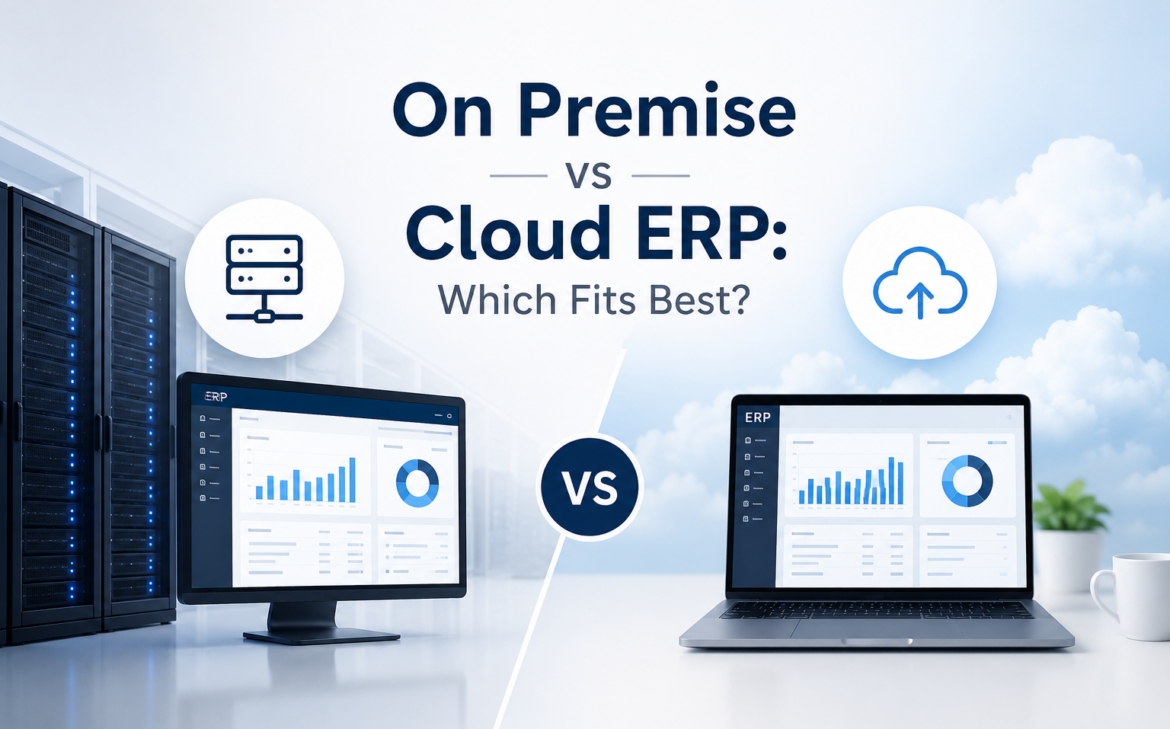
A surprising number of ERP projects go off track before implementation even starts, simply because the deployment model was wrong for the business. When leaders compare on premise vs cloud ERP, they are not just choosing where software lives. They are deciding how fast the company can adapt, how much control internal teams need, and what kind of cost structure makes sense over the next several years.
For growing companies, this is rarely a purely technical decision. It affects budgeting, compliance, reporting, IT workload, expansion plans, and the day-to-day experience of every team using the system. That is why the better question is not which model is better in general. It is which model better supports your operations, industry requirements, and growth plans.
On premise vs cloud ERP: the core difference
On-premise ERP is installed on servers owned or managed by the business. Your company is typically responsible for infrastructure, maintenance, backups, upgrades, and system availability, whether handled internally or through a partner.
Cloud ERP is hosted by the vendor or through a managed cloud environment and accessed over the internet. The provider usually handles the core infrastructure, while the business focuses more on configuration, process alignment, user adoption, and ongoing optimization.
That distinction sounds simple, but the business impact is significant. One model gives you deeper infrastructure control. The other gives you speed, flexibility, and a lower burden on internal IT.
Cost is not just about the license
Many companies begin with a basic assumption: on-premise means a larger upfront investment, while cloud means lower starting costs and predictable monthly or annual fees. That is generally true, but it does not tell the full story.
With on-premise ERP, costs often include hardware, database licensing, deployment services, security tools, backup systems, internal IT support, and future upgrade work. The initial capital expense can be substantial, especially if the business wants high availability or operates across multiple sites.
Cloud ERP usually shifts spending toward an operating expense model. That can be attractive for businesses that want to preserve cash flow, avoid infrastructure purchases, and scale gradually. However, subscription costs accumulate over time, and the total cost depends on user count, customizations, integrations, and support scope.
The right financial view is long-term. A five-year comparison is usually more useful than a first-year estimate. Businesses should also account for indirect costs, including downtime risk, manual work caused by poor system fit, and the internal effort required to maintain the platform.
Control matters, but so does responsibility
One of the strongest arguments for on-premise ERP is control. Some organizations want direct authority over servers, data storage, update timing, access layers, and internal policies. In sectors with strict internal governance or specialized operational setups, that level of control can be valuable.
The trade-off is responsibility. More control means more work. Your team or implementation partner must manage performance, patching, monitoring, backup routines, and disaster recovery planning. If internal IT capacity is limited, the burden can become expensive and distracting.
Cloud ERP reduces much of that infrastructure responsibility. For many small and mid-sized businesses, that is a major advantage. It allows management to focus on process improvement and reporting instead of maintaining servers and troubleshooting system performance.
This is where many decision-makers need a reality check. If your business says it wants full control but does not have the resources to support that control properly, cloud may be the more practical and lower-risk option.
Security in on premise vs cloud ERP
Security is often treated as the deciding factor in on premise vs cloud ERP, but the discussion is frequently oversimplified. Some companies assume on-premise is more secure because the system is inside the business. Others assume cloud is more secure because enterprise-grade providers invest heavily in protection.
Both views can be true depending on execution.
An on-premise ERP can be highly secure if the company maintains strong controls, reliable infrastructure, disciplined patch management, proper network security, and tested recovery plans. But many businesses underestimate how hard it is to maintain that standard consistently.
A well-managed cloud ERP can offer strong security, controlled access, regular updates, and dependable redundancy. Still, businesses must review where data is hosted, how access is governed, and whether the setup aligns with internal policies or regional compliance requirements.
For businesses in the Gulf region, the real issue is often not cloud versus on-premise in theory. It is whether the chosen deployment model supports data governance expectations, sector-specific obligations, and executive confidence. Security should be assessed based on actual architecture, provider standards, and operational discipline, not assumptions.
Scalability and speed to value
If your company is expanding into new branches, adding users quickly, or standardizing operations across locations, cloud ERP usually has the advantage. Deployment is often faster, user access is easier to extend, and infrastructure does not need to be rebuilt every time the business grows.
That speed matters. A delayed ERP rollout can slow financial visibility, inventory accuracy, customer service, and management reporting. For growth-oriented businesses, waiting months for infrastructure readiness can create unnecessary friction.
On-premise ERP can still scale, but expansion often requires more planning, more hardware consideration, and a higher internal support burden. That may be acceptable for organizations with stable operating models and low pressure for rapid change.
If agility is part of your strategy, cloud deserves serious consideration. If your environment is highly fixed, heavily controlled, or dependent on unique internal infrastructure, on-premise may still fit better.
Customization and integration realities
Many businesses evaluating ERP have one major concern: will the system adapt to how we actually work?
This is where deployment model and ERP design both matter. On-premise systems have traditionally been associated with deeper customization freedom, especially in older enterprise environments. That can be useful for businesses with highly specific workflows or legacy operational requirements.
But heavy customization has a cost. It can make upgrades slower, increase support complexity, and create long-term dependency on niche technical knowledge. What feels like flexibility at the start can become maintenance debt later.
Cloud ERP platforms have matured significantly. Many now support extensive configuration, modular deployment, and controlled customization without forcing businesses into rigid templates. For most small and mid-sized organizations, the better path is usually a balanced one: adapt the ERP to critical workflows, but also improve internal processes where standardization brings efficiency.
That is why ERP selection should never be separated from implementation strategy. The question is not only what the software can do. It is how the deployment model affects future upgrades, integrations, and business change.
Which businesses usually choose each model?
On-premise ERP often makes sense for companies with strict internal hosting requirements, existing infrastructure investments, complex legacy dependencies, or unusually high control needs. It can also suit organizations with strong in-house IT teams and a clear preference for managing environments directly.
Cloud ERP is often the better fit for businesses that want faster implementation, easier remote access, lower infrastructure overhead, and simpler scalability. It is particularly attractive for companies moving away from spreadsheets, disconnected tools, or outdated systems that no longer support growth.
For many mid-sized businesses, the decision comes down to operational maturity. If the goal is to modernize quickly, improve visibility, and avoid unnecessary technical burden, cloud is often the more commercially sensible route.
The best choice depends on business readiness
The strongest ERP decisions start with business realities, not product marketing. Leadership should evaluate internal IT capacity, budget model, compliance needs, expansion plans, customization requirements, and appetite for ongoing system ownership.
A good implementation partner will challenge assumptions here. Not every company that asks for on-premise truly needs it. Not every company that wants cloud is ready to standardize processes or manage change effectively. The right recommendation comes from understanding operations, risks, and growth targets in detail.
For businesses planning ERP transformation in Saudi Arabia and the wider Gulf, this assessment is especially valuable because deployment decisions often need to balance regional business practices, multi-entity operations, local reporting expectations, and long-term scalability. That is where an experienced partner such as Machinser can add real value, not by pushing one model blindly, but by aligning the system approach with business goals.
The better ERP model is the one your team can sustain, your leadership can justify, and your business can grow on with confidence.