A growing business usually reaches the same breaking point in different ways. Finance is using one system, sales is using another, inventory lives in spreadsheets, and management gets reports too late to act on them. That is where the odoo vs microsoft dynamics decision becomes practical, not theoretical. You are not just choosing software. You are choosing how your business will operate, scale, and respond under pressure.
For companies in distribution, manufacturing, trading, retail, services, and project-driven operations, both platforms are serious ERP contenders. Both can centralize processes, improve reporting, and reduce manual work. The difference is in how they get you there, how much control you have, and what the long-term investment looks like.
Odoo vs Microsoft Dynamics at a glance
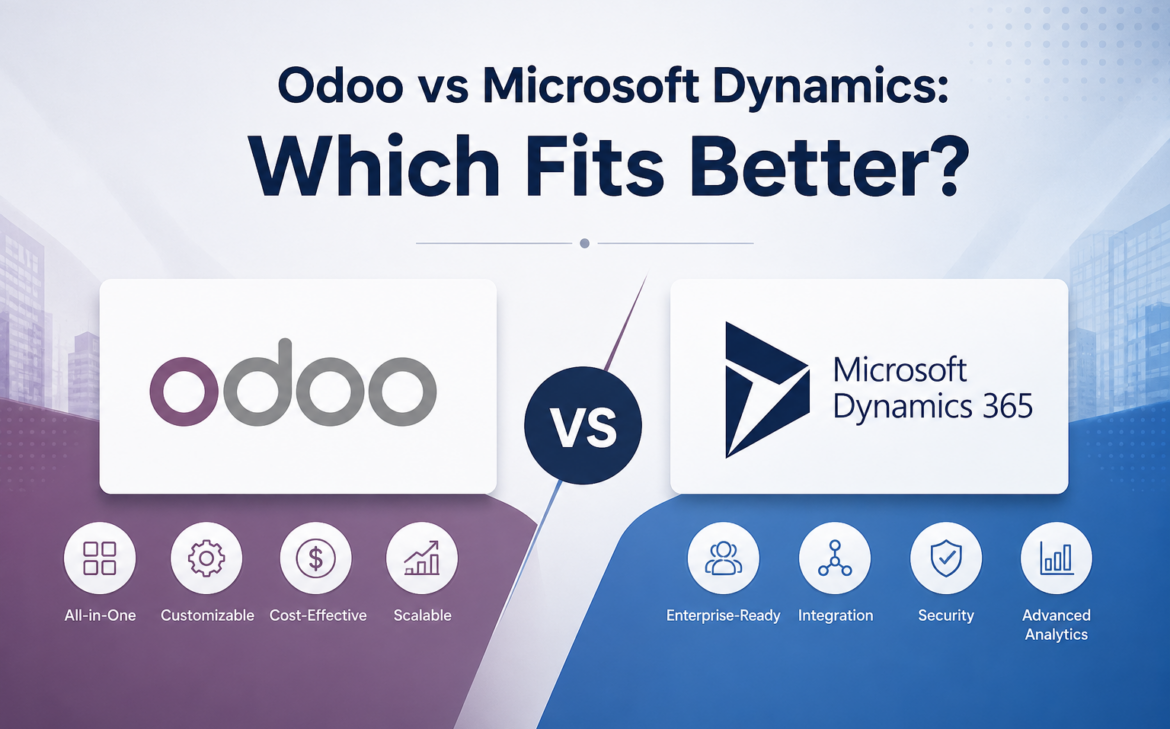
Odoo is often the better fit for businesses that want flexibility, faster implementation, and tighter control over cost. It is modular, highly customizable, and well suited to companies that need an ERP shaped around their workflows rather than the other way around. That matters for businesses with specific approval paths, regional requirements, or operational models that do not fit neatly into an out-of-the-box template.
Microsoft Dynamics, especially Dynamics 365, is typically chosen by organizations that are already deeply invested in the Microsoft ecosystem or have broader enterprise requirements across multiple departments, business units, or geographies. It offers strong functionality and familiar integration opportunities for teams already using Microsoft tools extensively. The trade-off is that it can become more expensive and more complex to implement and maintain.
Neither option is universally better. The right choice depends on your size, budget, process complexity, internal capabilities, and speed of transformation.
Where Odoo stands out
Odoo has earned attention because it gives businesses a wide functional range without forcing them into enterprise-level cost structures from day one. You can start with core modules like accounting, sales, inventory, purchasing, CRM, manufacturing, HR, or project management, then expand as needs grow. That phased approach is attractive for small and mid-sized companies that want progress without overcommitting.
Another advantage is customization. Many businesses in Saudi Arabia and the Gulf operate with local process requirements, bilingual environments, approval structures, and reporting expectations that need more than a standard ERP setup. Odoo is generally more adaptable in these scenarios. Custom workflows, dashboards, user permissions, forms, and integrations can be built without turning the project into a heavyweight enterprise program.
This does not mean Odoo is always simple. A poorly planned Odoo implementation can still create confusion, scope creep, and low user adoption. But when the system is designed properly around business priorities, it gives organizations a practical balance of capability and control.
Where Microsoft Dynamics stands out
Microsoft Dynamics is strong where scale, standardization, and ecosystem alignment matter most. For businesses already running Microsoft 365, Power BI, Azure, Teams, and other Microsoft products, Dynamics can feel like a natural extension of an existing environment. That familiarity can support adoption and reporting continuity.
It also appeals to larger organizations that want more formal enterprise structure, layered controls, and broad functionality across finance, operations, customer engagement, and service management. For companies with complex compliance needs, multinational operations, or large internal IT teams, Dynamics can be a comfortable choice.
The challenge is that comfort often comes with cost. Licensing, implementation effort, consulting hours, customization, and long-term support can add up quickly. For a mid-sized business trying to modernize efficiently, the platform may offer more system than the business actually needs at the current stage.
Cost is not just licensing
When buyers compare odoo vs microsoft dynamics, they often start with subscription pricing. That is reasonable, but it is only part of the picture. Total cost includes implementation, process design, customization, training, support, upgrades, and future expansion.
Odoo is usually more favorable on upfront and medium-term cost, especially for companies that want to implement in phases. You can focus budget on the modules that matter now, then add functionality as the business matures. This creates room for controlled transformation rather than a large one-time ERP overhaul.
Microsoft Dynamics may justify its cost in some environments, particularly where enterprise integration and standardization carry significant value. Still, many small and mid-sized businesses find themselves paying for complexity they are not yet ready to use fully. That is why financial comparison should always be tied to business fit, not feature volume.
Flexibility versus structure
This is often the real dividing line.
Odoo is built for adaptability. If your sales process, warehouse operations, manufacturing flow, service model, or approval cycle has unique requirements, Odoo is easier to shape around those realities. That can make a major difference for companies moving off spreadsheets or disconnected tools, because they do not have to force every team into a rigid process on day one.
Dynamics tends to bring more structure. In the right environment, that is a strength. It can enforce consistency across departments and support stronger governance. But for businesses that need quick responsiveness or operate in ways that change frequently, too much structure can slow progress. What looks like discipline in a demo can feel like friction during live operations.
A good ERP should improve process control without making normal work harder than it needs to be.
Implementation speed and project risk
ERP success is not decided at software selection alone. It is decided in implementation.
Odoo projects can often move faster, particularly for growing companies with clear scope and committed leadership. Because the platform is modular, businesses can prioritize immediate pain points such as invoicing delays, stock inaccuracy, weak reporting, or fragmented CRM activity, then build from there. Faster time to value matters when a business is already losing efficiency every month.
Dynamics implementations can take longer, especially when the project includes complex integrations, process redesign, multiple legal entities, or broad departmental rollout. Longer projects are not automatically bad, but they increase the importance of governance, internal ownership, and budget discipline.
This is where partner quality matters more than product marketing. The software may be strong, but if the implementation team does not understand your operation, the result will still disappoint.
Industry fit and customization needs
For trading businesses, distributors, manufacturers, retailers, and service organizations, Odoo often feels more commercially practical. It covers a wide range of core operations and can be tailored to match industry-specific requirements without pushing every client into the same blueprint.
That flexibility is especially valuable in markets where businesses need localized deployment, custom approvals, role-based visibility, or integration with existing systems. A consultancy like Machinser can bridge that gap by aligning Odoo with real business processes rather than treating implementation as a simple software install.
Dynamics can also support industry needs, but the route is often more formal and heavier. That may be right for some organizations. For others, it slows momentum and raises project cost before operational gains are visible.
Which businesses should choose Odoo?
Odoo is usually the better option for small to mid-sized businesses, fast-growing companies, and organizations that want a flexible ERP with controlled investment. It fits well when you need customization, phased rollout, better process visibility, and a system that can evolve with your business model.
It is also a strong choice when your teams need practical usability. Adoption improves when users feel the system matches how they actually work, not how a software vendor assumes they should work.
Which businesses should choose Microsoft Dynamics?
Microsoft Dynamics is often the better fit for larger companies, enterprises with significant Microsoft infrastructure, or organizations with more complex governance and cross-entity requirements. If your business already depends heavily on Microsoft platforms and has the budget, internal resources, and appetite for a broader enterprise program, Dynamics may be the right strategic investment.
The key is honesty about your current stage. Buying for a future version of the business that does not yet exist can create unnecessary cost and delay.
The best ERP decision is rarely about who has more features. It is about which platform helps your business move faster, operate with more control, and scale without adding avoidable complexity. If you evaluate odoo vs microsoft dynamics through that lens, the right answer usually becomes much clearer.